Real estate · Practical guide
After-Hours AI Receptionist for Real Estate: A Practical Guide
Plan after-hours real estate call handling with buyer and tenant scripts, human escalation rules, a rollout checklist and a worked measurement example.
Zlink AI Team8 min read
Listen to this article
AI narration · Fola voice · Gemini 3.8 Flash TTS
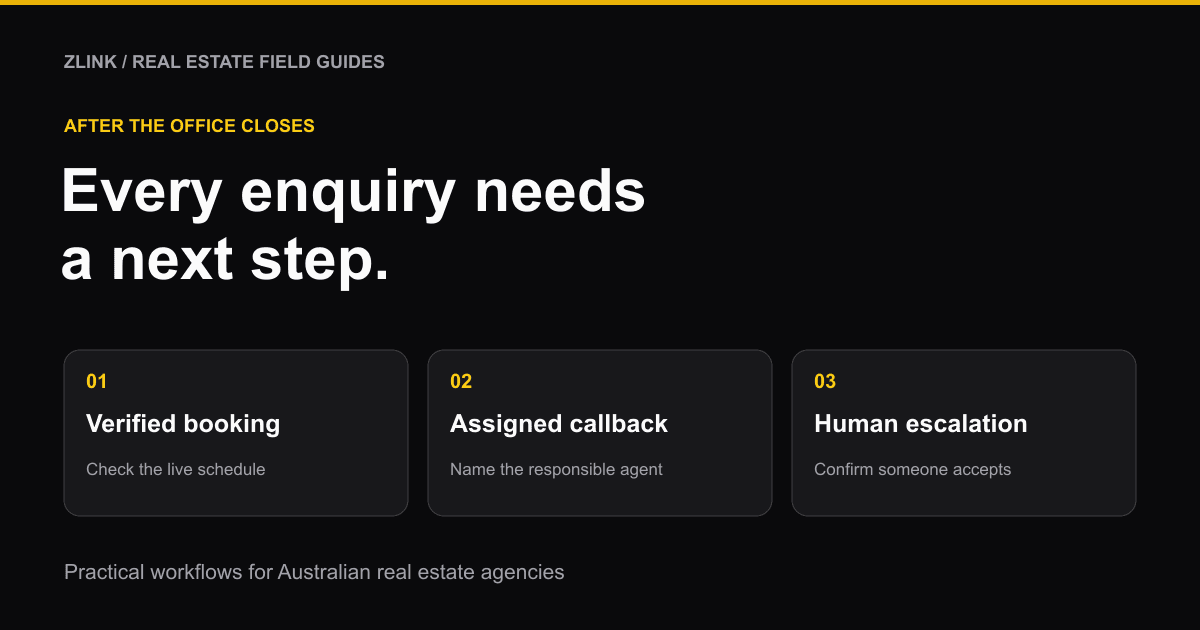
An after-hours AI receptionist can answer real estate calls, capture the property and caller's details, offer verified inspection times and route requests to the right person. Its value depends on what happens after the conversation: a saved booking, an assigned callback or a successful handoff.
For an Australian agency, a sensible first deployment is overflow and after-hours enquiry handling. Give it a limited job, current information and a person who owns exceptions. Keep negotiation, disputes and decisions about tenants with your team.
This guide is a proposed operating workflow, not a report of measured Zlink customer results. Use it to brief a provider and test your own office's call handling.
What should an after-hours real estate answering service do?
Start with the outcome each caller needs. A buyer asking for Saturday's open time does not need the same conversation as a landlord reporting a problem or a vendor asking for an appraisal.
- Buyer or renter: identify the listing, answer approved factual questions, offer a verified inspection or capture a request.
- Potential vendor: collect the property address and preferred callback time; offer an appraisal only if the correct agent's calendar supports it.
- Existing tenant: record the property, callback number and issue, then follow the agency's approved maintenance and escalation process.
- Existing landlord: identify the property and route to the responsible manager without revealing private tenancy details to an unverified caller.
- Caller who wants a person: try the appropriate available team member or offer a clearly assigned callback.
These are requirements to verify, not features every provider includes. Australian providers such as Voqo advertise property enquiry handling and after-hours coverage. A feature list still needs to be demonstrated with your listings, phone setup and staff roster.
Build a call flow that finishes with an owner
Use this sequence as a starting point. Adapt the words to your agency and have the person responsible for privacy approve the final greeting and recording process.
- Introduce the service. Identify the agency and the AI assistant. Explain recording or transcription where applicable using your approved notice and consent process.
- Identify the purpose. Ask what the caller needs before collecting a long list of details.
- Resolve the property. Confirm the unit number, street and suburb, or the listing reference. Read back ambiguous addresses.
- Choose the action. Retrieve approved information, attempt a booking, route to a person or save a callback.
- Confirm the result. Say what actually happened and who owns the next step. A request is not a confirmed appointment.
- Record the outcome. Save the caller's details, property, action, owner and due time in the team's working system.
An email summary may be enough for a low-volume pilot if a named staff member checks it. At higher volumes, an unassigned inbox becomes another place for enquiries to wait. Agree a fallback for failed CRM delivery and make that queue visible to someone.
Three scripts to adapt for your agency
These examples are fictional. The assistant should use verified facts and actual staff availability when replacing the placeholders.
A buyer wants an inspection
“You've reached [agency]'s AI assistant. I can help with property enquiries or arrange a callback. Which property are you calling about?”
After confirming the listing: “I can check the current inspection times. Would you like me to do that?” If the booking system confirms a place, read back the address, full date and local time. If it fails, say: “I couldn't confirm a booking. I can send the leasing team a request and ask them to contact you.”
Keep the questions proportionate. Ask for a name and contact method needed for the booking. A caller asking about an open home should not have to disclose detailed financial information before hearing the time.
A vendor calls after dinner
“I can ask the sales team to contact you about an appraisal. What is the property address, and when would you prefer a callback?”
Confirm the callback number and assign the enquiry to the correct agent. Do not turn an appraisal request into an automated price estimate. If the requested time is unavailable, offer a realistic alternative rather than promising that an agent will call immediately.
A tenant needs help after hours
“Please tell me the property address, your callback number and what's happened. I'll use the agency's after-hours process to get your request to the right person.”
The assistant needs an agency-approved urgency policy, a current on-call roster and a fallback contact. It should escalate uncertainty instead of guessing whether a repair can wait. It must not promise a contractor has been dispatched unless that action has been confirmed. The phone assistant is not an emergency service or a substitute for your tenancy and emergency procedures.
What happens if the on-call person does not answer?
Write the failure path before launch. Define how long each contact should ring, what counts as acceptance, which backup to try and what the caller should hear if nobody is reachable. Avoid a loop that transfers the call back into the same AI number.
A transfer attempt is not the same as a successful connection. For example, Retell's transfer documentation distinguishes cold transfers from warm transfers that can keep the assistant involved during the handoff. The available behaviour depends on configuration and telephony support. Ask the provider to demonstrate the exact result when the destination is busy, unanswered or voicemail.
For time-sensitive requests, an emailed summary alone does not establish that someone accepted responsibility. Log whether a person acknowledged the request and make unacknowledged escalations visible to the duty team.
Measure useful outcomes, not just answered calls
Before changing the phone routing, export a representative period of call logs. Separate business hours from after hours and mark spam, repeat calls, existing-client calls and new enquiries. Protect caller data when sharing the log with a provider.
During the pilot, track the number of relevant calls, accurate contact captures, confirmed bookings, completed human handoffs and callbacks completed by the agreed deadline. Review incorrect answers, failed transfers and complaints separately. A high answer rate can coexist with poor follow-up.
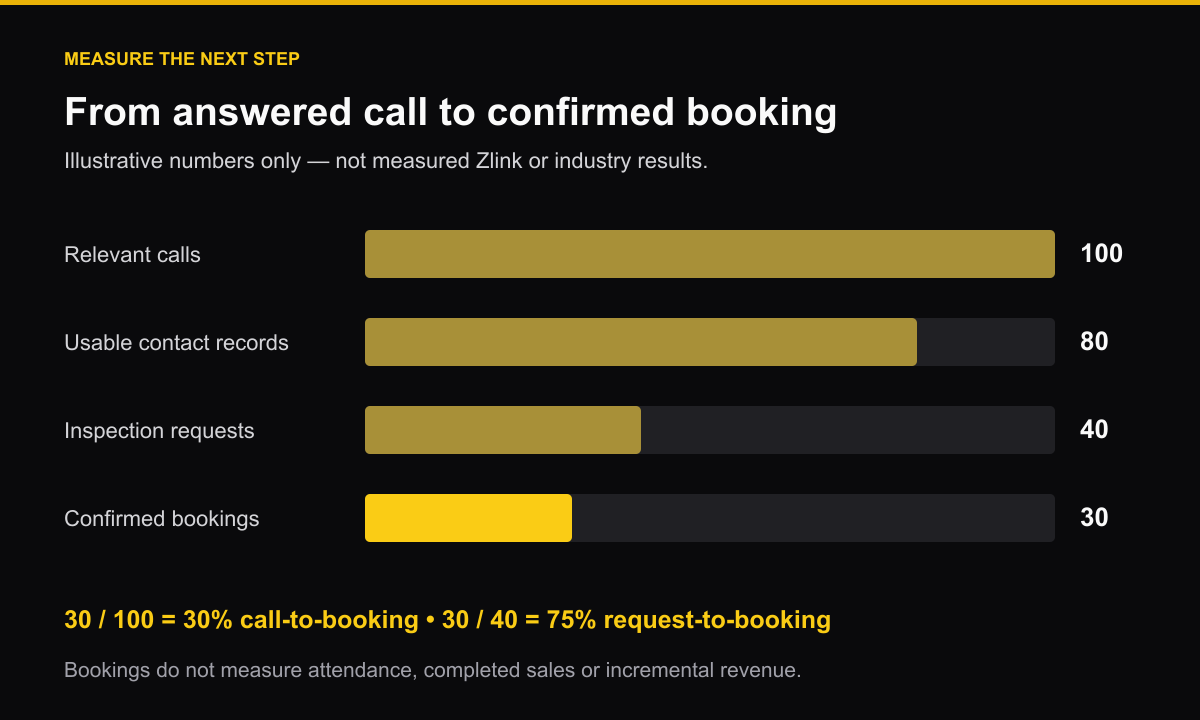
The graph uses invented example numbers: 100 relevant calls produce 80 usable contact records, 40 inspection requests and 30 confirmed bookings. That means a 30% call-to-booking rate and a 75% request-to-booking rate. Neither figure measures attendance, sales or incremental revenue. Different denominators answer different questions.
Compare similar periods, record changes in listing stock and marketing, and check what would have happened without the AI. A booking is useful; calling every booking a recovered sale is not a defensible return calculation. The Australian AI receptionist cost guide covers pricing questions to include in that evaluation.
Privacy and outbound follow-up need separate decisions
The OAIC's guidance on commercial AI recommends assessing data handling and human oversight and clearly identifying public-facing AI tools. Ask who can access recordings, where information goes, how long it is retained and whether suppliers use it for training. Have applicable privacy and state or territory recording obligations reviewed; a greeting alone does not establish compliance.
An inbound answering workflow does not automatically authorise an outbound marketing campaign. ACMA explains that telemarketing is defined by the purpose of the call. If you add promotional callbacks, assess consent, Do Not Call Register obligations, permitted times and opt-out handling for that workflow.
A practical rollout plan
Start with a small, clearly defined call group. Supply current listings, office hours, routing rules, approved answers and the escalation roster. Nominate an operational owner and a backup who can change forwarding if the service fails.
Run the 15-call testing checklist before diverting public traffic. Include a wrong address, unavailable inspection, caller requesting a human, failed CRM save and unanswered transfer. Fix failures before extending the scope.
In the first week, review each pilot call and its final record. After the workflow stabilises, keep a regular sample review plus a review of every complaint or failed action. Update the knowledge source whenever an inspection time, listing status or roster changes. Record who made each change so an old answer can be traced back to its source.
Frequently asked questions
Can we keep our existing real estate phone number?
Often a provider can receive diverted calls, but the setup depends on your carrier and phone system. Confirm forwarding charges, caller ID, overflow rules and how to restore the previous routing. Test using a normal phone call rather than relying only on a browser demo.
Can the AI book inspections after hours?
Yes, if your chosen setup has authorised access to current availability and can save a booking successfully. Otherwise it should collect an inspection request. See the inspection booking and CRM workflow for the distinction.
Does this replace a property manager or receptionist?
It can cover defined phone tasks. It does not take ownership of relationship management, tenancy decisions, disputes or the physical work of managing properties. Decide which calls your team wants to retain before selecting automation.
What should we show a provider in a demo?
Bring a small set of fictional callers, sample listings, your desired escalation rules and the CRM fields your team actually uses. Ask the provider to show the saved record and any failed-action alert, not only the conversation.
Plan your agency's call flow with Zlink
Zlink's AI call agent service is a starting point for discussing your agency's requirements. Bring your call volumes, software names and the three calls your team most needs help with. Ask us to demonstrate the required integrations and fallback paths before agreeing the scope. Arrange a conversation with Zlink.
Sources were reviewed on 19 October 2026. The scripts, workflow and illustrative numbers are editorial examples, not a client case study or a guarantee of results.