AI Insights · Practical guide
Humanoid Robots in Australia: Prices, Uses and Limits in 2026
What humanoid robots can and can't do for Australian businesses in 2026: prices from 13 local sellers, BMW and Figure results, how fast prices are falling, Elon Musk's predictions and what it means for jobs.
Zlink AI Team15 min read
Listen to this article
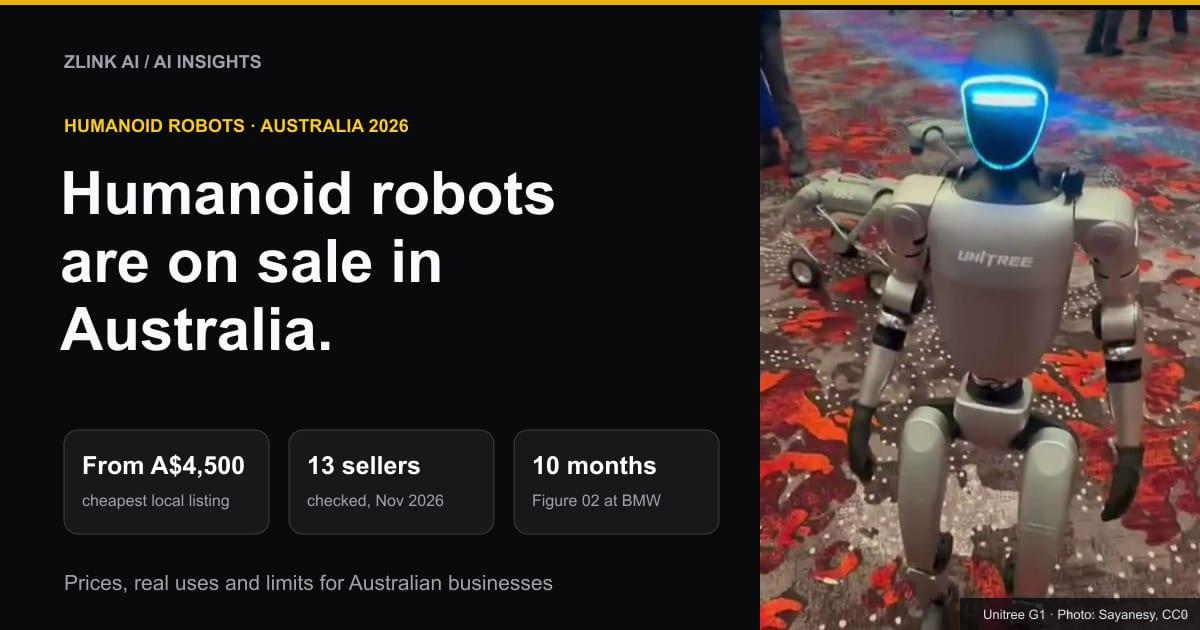
A humanoid robot is a robot built in the shape of a person, with a head, a body, two arms and usually two legs. Our homes, shops and factories are built for human bodies, so a robot shaped like us can, in theory, walk through the same doors, climb the same stairs and use the same tools. In 2026 you can buy one in Australia for less than the price of a small car.
This guide explains, in plain English, what humanoid robots can and can't do for Australian businesses today, what they cost here, how fast prices are falling, and what it could mean for jobs and the price of everything we buy.
A quick note: Zlink AI builds AI software for Australian businesses, such as AI receptionists and automation. We don't sell robots and no seller below has paid to be included. Every number links to its source, and we checked each seller's website on 18 November 2026.
The short answer
- Humanoid robots are on sale in Australia right now. We found 13 local sellers. Prices start at A$4,500 for a small education robot and about A$12,800 for a Unitree R1. The popular Unitree G1 starts at about A$30,600.
- They are already working overseas. A Figure humanoid robot helped build more than 30,000 BMW cars in the United States over 10 months.
- But they are not ready to replace a worker yet. Today's humanoids are slower than people, run for a few hours per charge and carry light loads. Most Australian buyers are universities, schools, event companies and early-adopter businesses.
- Prices are falling very fast. The cheapest walking humanoid dropped from US$16,000 to about US$1,400 in 17 months.
- The predictions are huge. Elon Musk says there will be more robots than people. Morgan Stanley expects more than a billion humanoids by 2050.
- People will still want people. Robots will take on the heavy, repetitive and dangerous work first. Jobs built on human connection, care and trust are not going away.
What is a humanoid robot?
A humanoid robot uses motors in its joints, cameras and sensors to see, and AI to decide how to move. Most humanoids for sale today fall into four groups:
- Full-size humanoids about the height of an adult, such as the Unitree H1 and H2, Figure 03 and Tesla Optimus. These are built for work in factories and warehouses.
- Mid-size humanoids about 1.3 metres tall, such as the Unitree G1 and AgiBot X2. These are mostly used for research, education, events and demos.
- Small humanoids such as the Unitree R1 (about 1.2 metres) and the kid-sized Noetix Bumi. These are mostly for learning, coding and entertainment.
- Wheeled humanoids, with a human-like top half on a wheeled base. They can't climb stairs, but they are more stable and their batteries last longer.
The body is only half the story. The big change in the last two years is the AI "brain". The same kind of AI that powers ChatGPT is now being trained to see, understand spoken instructions and control a robot body. That is why companies are moving so much faster than before.
How fast are humanoid robots moving?
BMW: the first real factory test
BMW is the best example of a large company using humanoid robots on a real production line.
At its plant in Spartanburg, in the United States, a Figure 02 robot worked for 10 months on the BMW X3 production line. It ran 10-hour shifts, five days a week, moving sheet metal parts for welding. According to BMW Group, it:
- helped build more than 30,000 BMW X3s
- moved more than 90,000 parts
- worked about 1,250 hours
- walked about 1.2 million steps.
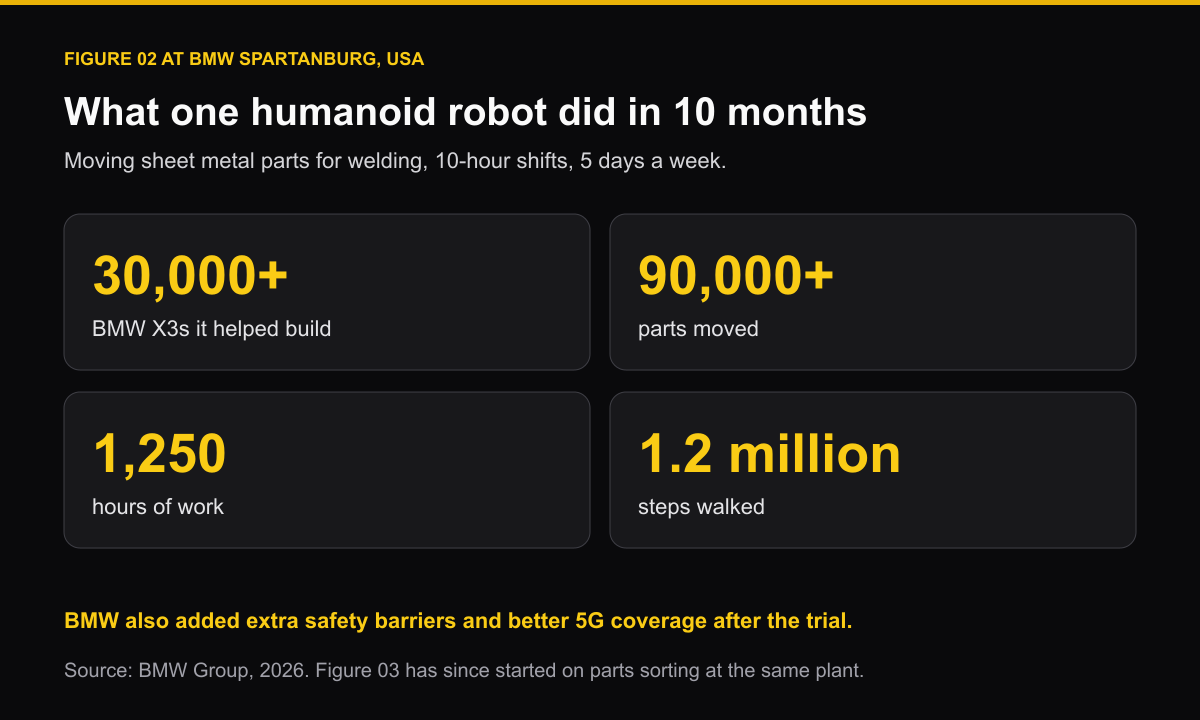
The trial also taught BMW some lessons. It added extra safety barriers and better 5G coverage in the factory hall. In June 2026, the newer Figure 03 started a harder job at the same plant: sorting mixed parts into trolleys in the right order for the assembly line (Figure, BMW Blog).
BMW is testing other robots too. At its Leipzig plant in Germany, a wheeled humanoid called AEON, made by Hexagon, started work in December 2025. It helps with high-voltage battery assembly and delivers materials to the line (BMW Group).
Figure: from one robot a day to one an hour
Figure AI is a US company based in San Jose, California. It was valued at US$39 billion in September 2025 (Figure). Its growth shows how quickly this industry is moving:
- In April 2026, Figure said its factory, called BotQ, had delivered more than 350 Figure 03 robots. It had sped up from building one robot a day to one robot an hour in less than 120 days (Figure).
- In November 2026, chief executive Brett Adcock said Figure now has "well over a thousand" robots on its campus, compared with roughly 700 to 800 staff. So the robots now outnumber the people. He said the factory could build more than 40,000 robots a year at full speed (Humanoids Daily).
- At Figure's headquarters, robots greet visitors, open doors and use the stairs and lifts. The goal is for a visitor to check in and find their way around without talking to a person (Humanoids Daily, Sourcery).
A caution: most of these numbers come from Figure itself. Videos of its campus show dozens of robots walking around, but Humanoids Daily notes that Figure hasn't said how many of its robots do paid work for customers.
China is making them by the thousands
Most humanoid robots sold in Australia are made in China. Analysts at Omdia estimate about 15,000 humanoid robots were shipped worldwide in 2025, and two Chinese companies, Unitree and AgiBot, shipped more than 5,000 each (AP via KATU). Chinese factories are producing far more in 2026 (ABC News).
What humanoid robots can do for businesses today
Here is where humanoid robots are actually being used, not just shown off:
- Moving parts and boxes in factories. Figure 02 moved sheet metal at BMW. In the US, Agility Robotics' Digit robot has moved more than 100,000 plastic tubs at a GXO warehouse (ASCLA).
- Sorting parts for a production line. This is Figure 03's new job at BMW.
- Greeting and guiding visitors. Robots work as greeters at Figure's office, and as concierges and sales assistants in some hotels and shops in China (ABC News).
- Keeping people company in aged care. Melbourne start-up Andromeda makes a humanoid companion robot called Abi. Aged care provider mecwacare now has 22 Abi robots across its homes in Victoria, supporting more than 1,500 residents. Abi sings, tells stories and can speak up to 90 languages (mecwacare).
- Events, marketing and shows. You can hire an AgiBot humanoid in Melbourne from about A$2,750 for half a day (SilkGear).
- Research and training. Universities and tech teams buy developer versions to build and test their own robot skills.
- Testing in dangerous places. In 2023, Woodside Energy in Perth tested NASA's Valkyrie humanoid for remote work at offshore energy sites (ASCLA).
What humanoid robots can't do yet
This is the part the videos don't show. Based on Deloitte research summarised by the Australasian Supply Chain & Logistics Association (ASCLA):
- They are slower than people. Today's humanoids work at about 30% to 50% of the speed of a person doing the same task.
- Their batteries run out quickly. Most last 2 to 4 hours per charge. A purpose-built warehouse robot can run for 10 to 20 hours.
- They can't carry much. Most handle 10 to 15 kg comfortably, which rules out a lot of heavy carton and box work.
- They need safe spaces. Even BMW added barriers around its humanoid. They are not yet safe to work shoulder to shoulder with people everywhere.
- Messy places are hard. A factory station that's the same every day is much easier than a building site, a busy kitchen or a home.
- Few are doing real work yet. Interact Analysis estimates only about 1 in 10 humanoids made in 2025 went into real-world jobs. And as of August 2026, no Australian warehouse had publicly announced even a humanoid trial (ASCLA).
- The cheap versions are mostly for demos. "Basic" models usually can't be programmed by you. For example, Pakronics lists its Unitree R1 Basic as "non programmable" (Pakronics). To teach a robot a new task, you need a developer (EDU) version, which costs two to three times more.
There are also security questions. In July 2026, the US banned new models of foreign-made humanoid robots over national security and cybersecurity concerns (AP via KATU). Australia has no such ban, but these robots carry cameras and microphones, so ask where their data goes.
Where to buy a humanoid robot in Australia, and what it costs
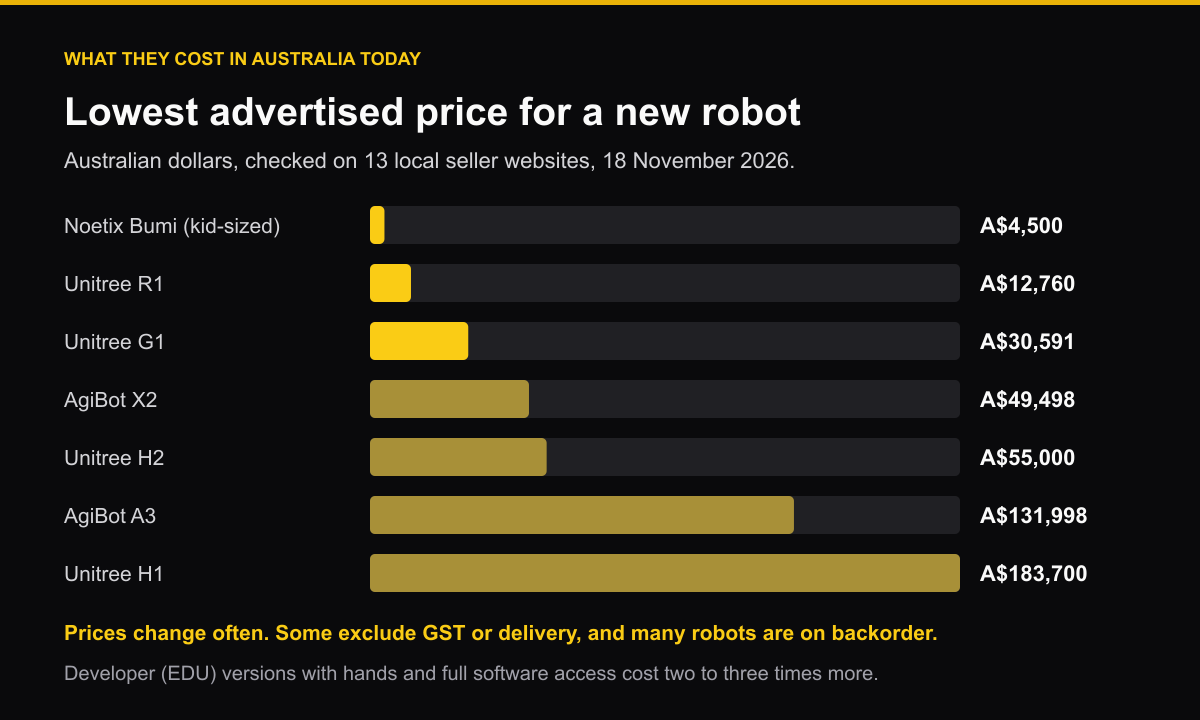
These are the Australian sellers we checked on 18 November 2026. Prices change often. Some include GST and some don't, and many robots are on backorder, so always get a written quote.
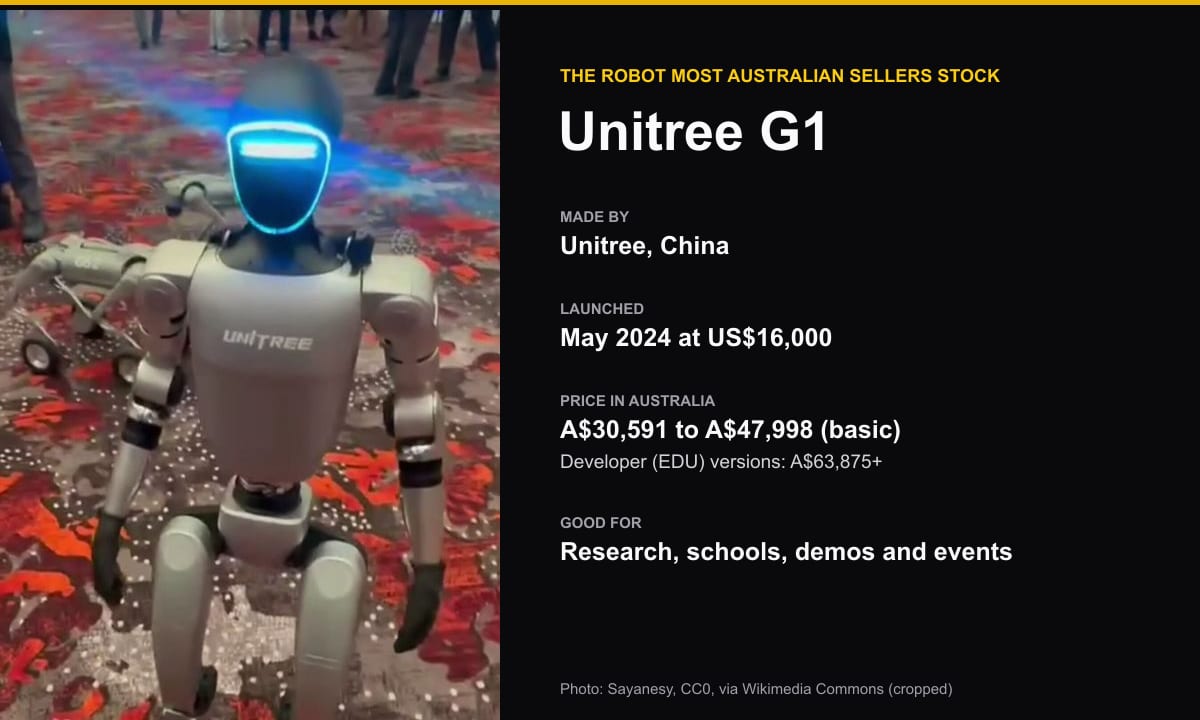
Unitree G1. Photo: Sayanesy, CC0, via Wikimedia Commons, cropped.

Unitree sellers
- RobotHaus (Brisbane, ships nationwide): Unitree R1 from A$12,760, G1 from A$38,720, H2 from A$110,110 and H1 at A$187,000, including GST. Offers setup, training, servicing and Australian support.
- E-Ozzie (Melbourne, Sydney and Perth): Unitree R1 Air A$14,746, R1 Basic A$16,990, G1 Basic A$34,796, G1 EDU from A$64,481 and H2 A$74,731 on pre-order. Also sells robot induction training from A$1,500.
- Robots Australia (online store): Unitree G1 Basic A$30,591, R1 Basic A$15,284, H2 A$57,373, R1 EDU A$24,403 and G1 EDU from A$63,875. Check local support before you buy.
- ROBAU (Melbourne): Unitree G1 A$42,835, G1 EDU A$82,500, G1 EDU with dexterous hands A$127,567 and H1 A$183,700.
- Roboworks (Sydney): Unitree G1 from A$42,066 and H1 from A$186,664.
- C.R. Kennedy (Melbourne, nationwide): Unitree R1 A$17,050 and H2 A$110,110, with G1 by quote. These were on backorder, with stock expected in January 2027.
- Robot Specialist (Cheltenham, Melbourne): Unitree R1 Basic A$16,995.
- Pakronics (Thomastown, Melbourne): Unitree R1 Basic A$15,400 and G1 Basic A$42,835. Both were out of stock.
- 3D Printer Superstore (Geelong): Unitree R1 A$13,189. Sold out.
- Georges Cameras (Sydney): Unitree G1 A$47,997.60, awaiting stock.
AgiBot and other brands
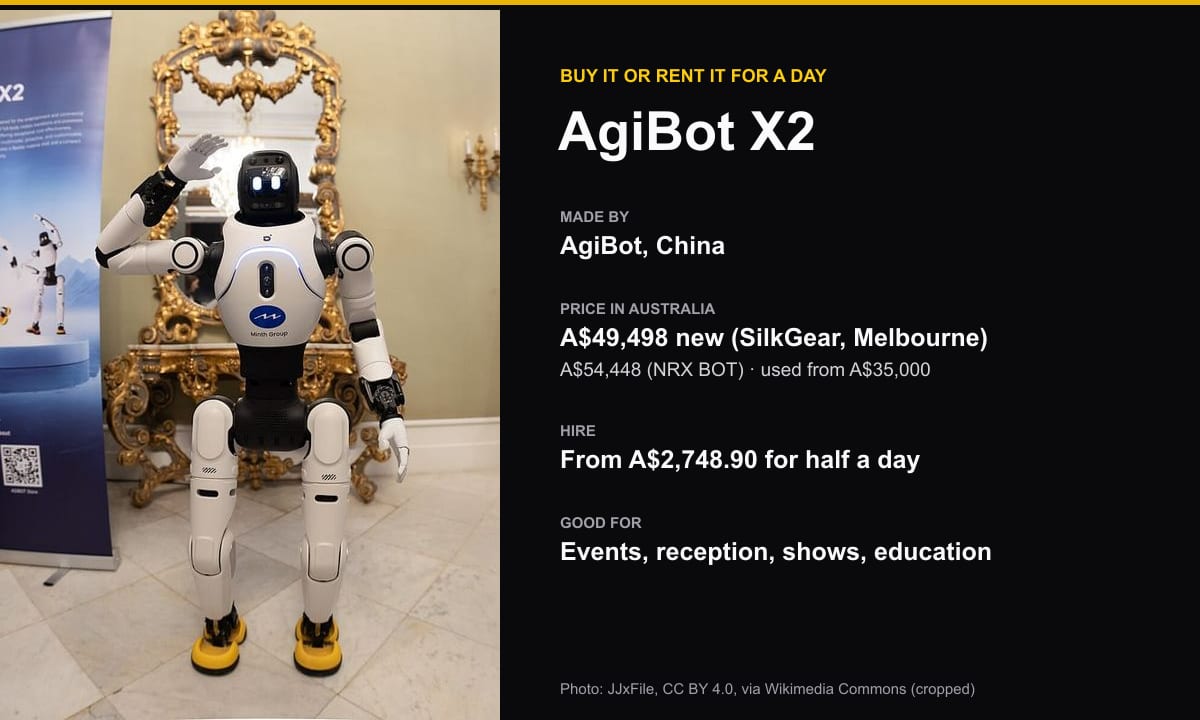
AgiBot X2 at MWC 2026. Photo: JJxFile, CC BY 4.0, via Wikimedia Commons, cropped.

- SilkGear (Melbourne CBD showroom): AgiBot X2 A$49,498, X2 Ultra A$82,498 and the full-size A3 A$131,998. Also rents robots for events, from A$2,748.90 for half a day for an X2 Lite.
- NRX BOT Australia (Melbourne): BOT X2 A$54,447.80, A2 Lite A$81,423.60, A2 Ultra A$90,747.80, A3 A$145,197.80 and A3 Ultra A$199,647.80.
- Sonny Robotics (Mount Waverley, Victoria): the widest range we found, including Noetix Bumi from A$4,500, Unitree R1 from A$15,000 and Unitree H2 from A$55,000. Many listings are used robots, such as a used Unitree G1 from A$19,000 and a used AgiBot X2 from A$35,000.
Before you buy, check these things
- Basic or EDU? Make sure the version you're buying can actually do what you need.
- The full price. Ask if GST, delivery, batteries, a controller and setup are included. A spare G1 battery alone costs about A$1,300 to A$1,500.
- Stock and delivery date. Many listings are backorders.
- Local warranty and spare parts. Who fixes it in Australia, and how fast?
- Training. Who will teach your staff to use it safely?
- Safety. You must manage the risks of any machine at work, and a robot is no different. SafeWork NSW has guidelines for working safely with collaborative robots that are a good starting point.
- Data and privacy. Where do the camera and microphone recordings go?
How fast are humanoid robot prices falling?
Very fast. Look at the launch prices of the cheapest walking humanoids:
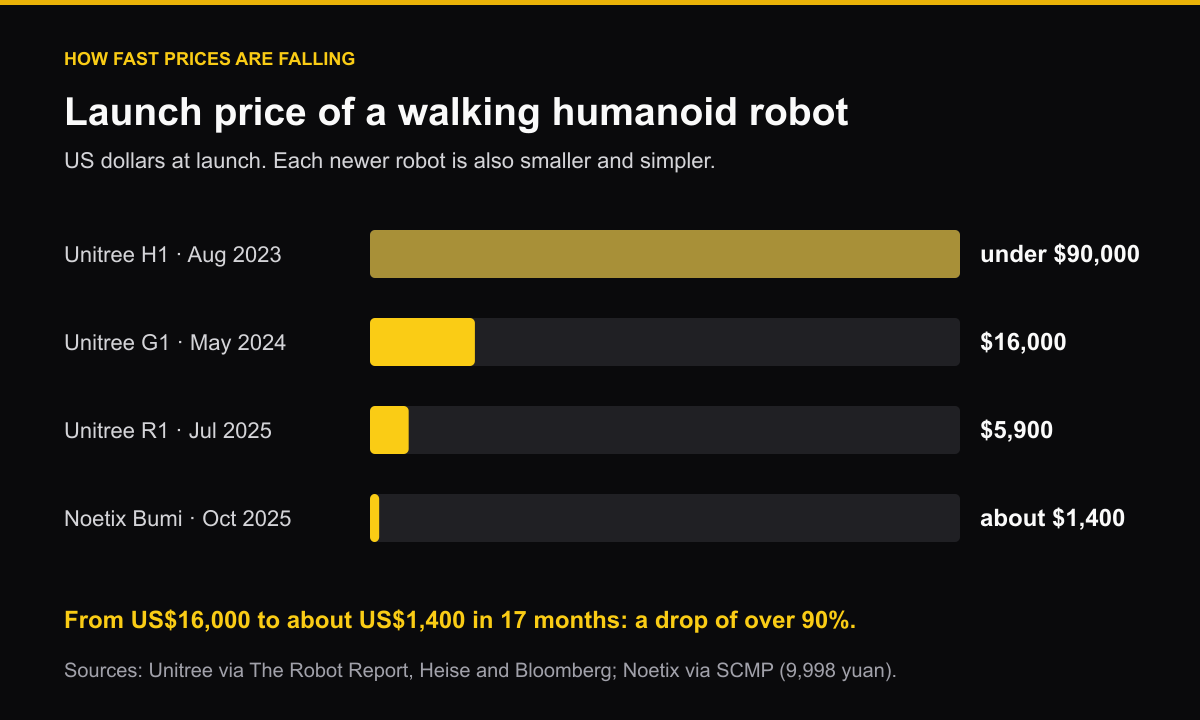
- Unitree H1, August 2023: priced at under US$90,000 (The Robot Report)
- Unitree G1, May 2024: US$16,000 (Heise)
- Unitree R1, July 2025: US$5,900 (Bloomberg)
- Noetix Bumi, October 2025: 9,998 yuan, about US$1,400 (SCMP)
To be fair, each newer robot is also smaller and simpler. But the cost of making the big ones is falling too. Goldman Sachs found that the cost of making a humanoid robot fell about 40% in a single year, from US$50,000–$250,000 to US$30,000–$150,000 (Goldman Sachs).
The big companies are aiming even lower:
- Elon Musk says Tesla's Optimus should eventually cost US$20,000 to US$30,000, less than a car (I Programmer).
- Figure's Brett Adcock says a home robot would need to lease for about US$300 to US$500 a month (Humanoids Daily).
How that compares with a worker's wage
The average full-time adult in Australia earns A$2,083.70 a week, or about A$108,000 a year before super (ABS). A basic Unitree G1 costs roughly what an average worker earns in four to five months.
That doesn't mean a G1 can replace a worker. It can't do most jobs yet, it works at a fraction of a person's speed, and the version you can train costs much more. Deloitte estimates a first fleet of five humanoids costs US$800,000 to US$2 million and takes about six years to pay for itself. But each extra robot pays for itself in about two years, and that could fall towards seven months by 2030 if prices keep dropping (ASCLA).
That is the real story. The robots are not cheap enough or good enough to replace most workers today. But the price is falling and the skills are improving every few months.
Elon Musk: will there be more robots than people?
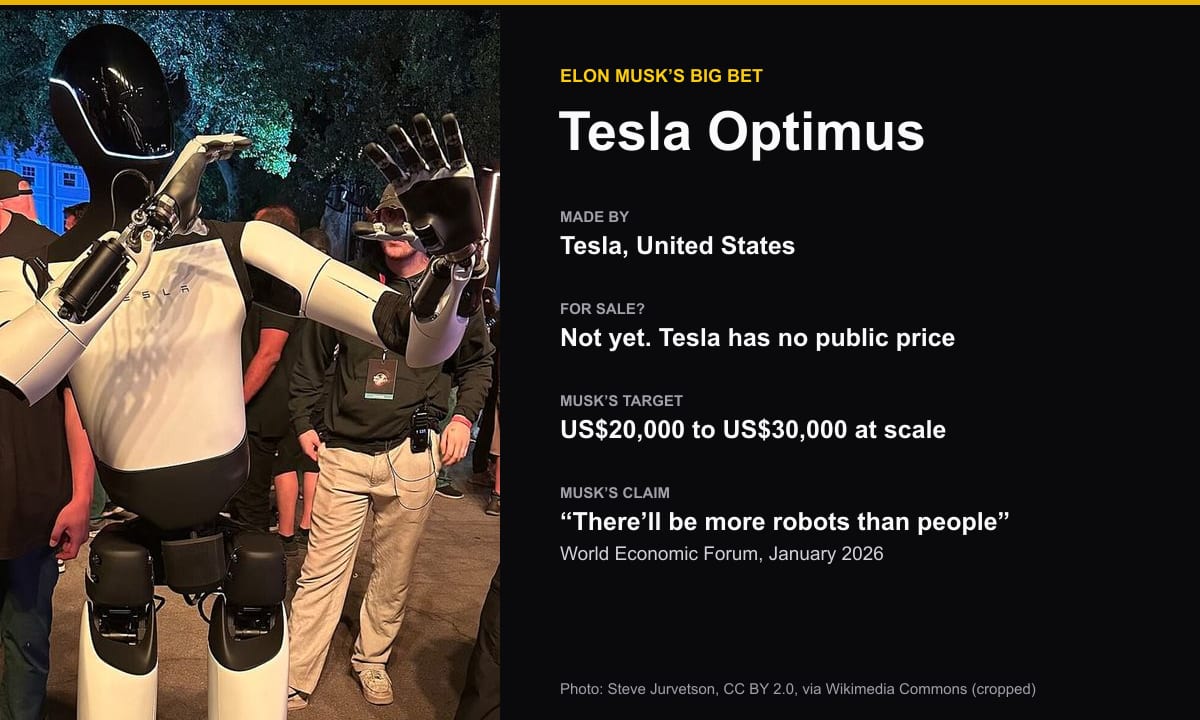
Tesla Optimus at Tesla's We, Robot event, October 2024. Photo: Steve Jurvetson, CC BY 2.0, via Wikimedia Commons, cropped.

Elon Musk has been saying this for years. In 2023 he said humanoid robots might one day outnumber humans (Fortune). At the World Economic Forum in Davos in January 2026, he said it again: "there'll be more robots than people" (World Economic Forum).
In the same talk, Musk said:
- he expects everyone on Earth will want their own humanoid robot
- Tesla could be selling humanoid robots to the public by the end of 2027
- robots and AI will create such an abundance of goods and services that they could meet everyone's needs.
Other forecasts are more modest, but still huge. Morgan Stanley expects more than 1 billion humanoid robots in use by 2050, in a market worth around US$5 trillion. Most would work in factories and businesses, not homes (Morgan Stanley). For comparison, the UN expects the world to have about 9.7 billion people by 2050 (United Nations).
So more robots than people is possible one day, but probably not soon. Musk has admitted he is often too optimistic about timelines (Benzinga). Even Tesla's Optimus was still not on sale when we wrote this.
What it means for the cost of everything
Here's the big idea behind the excitement. Almost everything we buy has people's work built into its price. Someone made it, packed it, moved it, stored it, cleaned up after it and delivered it.
If a robot that costs about as much as a car can do some of that work for many hours a day, the cost of that work falls. Musk's view is that this leads to a world where goods become much cheaper and far more plentiful.
What this could mean in practice:
For businesses (B2B)
- Factories, warehouses and logistics will benefit first, because their tasks repeat and their sites can be set up for robots. BMW is the early proof.
- Mining, cleaning and facilities are next in line in Australia. AgiBot's local robot rental network is targeting mining, commercial cleaning, research, education and entertainment (ASCLA).
- Hard-to-fill jobs such as night shifts, heavy lifting and hot or dangerous work could be covered when you can't find staff.
- Robots as a service. Instead of buying a A$50,000 robot, many businesses will rent or lease, paying monthly like a car or a phone plan.
For customers
- Cheaper goods over time. When making and moving things costs less, competition usually pushes prices down. But the savings will arrive slowly, one industry at a time, not overnight.
- Robots at home. Figure and Tesla are both aiming for home robots that tidy, do laundry and help older people. Both have said home robots are close, but neither had one on sale in Australia when we wrote this.
The honest view: the first savings will go to the businesses that use robots well. Customers will see lower prices later, as more businesses catch up and compete.
Will humanoid robots take Australian jobs?
Some jobs will change, and some tasks will go. That's been true of every new technology, from the tractor to the computer. Here's what is most likely:
The hardest work goes first. Robots will start with jobs that are heavy, repetitive, dirty or dangerous. BMW says its humanoids take on work that is repetitive, precise or physically demanding (BMW Group). Few people will miss lifting the same heavy part 1,000 times a shift.
Jobs built on human connection stay human. People want to deal with people when it matters. Think of a nurse at your bedside, a tradie you trust in your home, a teacher, a real estate agent, a counsellor or a good waiter. Even Abi, the aged care robot, is a companion that sings and chats. It doesn't replace the carers, and staff call it their "Happiness Assistant" (mecwacare).
We've written about why people still want the human touch in why humans hang up on bad AI and why Porsche's "no AI" ad went viral.
New jobs are already appearing. Someone has to sell, set up, program, repair, insure and safety-check these robots. Australian sellers already offer robot setup, servicing and staff training.
Should your business buy a humanoid robot in 2026?
For most Australian businesses, not yet, but it's worth watching closely.
It may make sense now if you:
- run research, education or training programs
- want a crowd-pleaser for events, marketing or a showroom (renting is a cheap way to test this)
- have one simple, repeatable task and want to learn early, before your competitors.
It's better to wait if you:
- need a full day's work from one machine
- need to lift heavy loads
- work in a messy, changing place like a building site or a busy kitchen.
Look at other automation first. Purpose-built warehouse robots, robot arms and AI software often pay off today, while humanoids are still catching up. And a lot of everyday business work, such as answering calls, booking appointments and following up leads, doesn't need a robot body at all.
What this means for Australian businesses using AI today
The "brain" inside a humanoid robot is the same kind of AI that can already answer your phones and chat with your customers. You don't need a A$40,000 robot to start using it.
Zlink AI builds AI receptionists, AI chat agents and AI automation for Australian businesses, from builders and trades to clinics. Book a free consultation and we'll help you find where AI saves you time and money today, while the robots catch up.
Frequently asked questions
How much does a humanoid robot cost in Australia?
In November 2026, prices start at about A$4,500 for a small education robot like the Noetix Bumi and about A$12,800 for a Unitree R1. The popular Unitree G1 costs about A$30,600 to A$48,000 for the basic version. Full-size work robots such as the Unitree H1 cost about A$184,000 to A$187,000. Developer versions cost two to three times more than basic ones.
Can I buy a humanoid robot in Australia?
Yes. At least 13 Australian sellers list humanoid robots, including RobotHaus, E-Ozzie, ROBAU, C.R. Kennedy, SilkGear and Sonny Robotics. Many models are on backorder, so check stock, delivery dates and local support before you pay.
What is the cheapest humanoid robot in Australia?
The cheapest we found was the Noetix Bumi from A$4,500 at Sonny Robotics. It's a kid-sized robot for learning and fun. The cheapest Unitree humanoid was the R1 from A$12,760 at RobotHaus.
Does BMW use humanoid robots?
Yes. A Figure 02 humanoid worked for 10 months at BMW's Spartanburg plant in the US and helped build more than 30,000 BMW X3s. The newer Figure 03 started sorting parts there in 2026, and BMW is also testing a Hexagon AEON robot at its Leipzig plant in Germany.
How many robots does Figure have?
In November 2026, Figure's chief executive Brett Adcock said the company has "well over a thousand" robots on its campus, more than its 700 to 800 staff. Figure said its factory can now build a robot an hour.
Will there be more humanoid robots than humans?
Elon Musk predicts there will be. Morgan Stanley forecasts more than 1 billion humanoid robots by 2050, while the world is expected to have about 9.7 billion people by then. So it's possible one day, but not in the next few years.
Will humanoid robots replace jobs in Australia?
They will take over some tasks, starting with heavy, repetitive and dangerous work. Today's humanoids work at only 30% to 50% of a person's speed. Jobs that rely on human connection, care, trust and judgement are likely to stay human, and new jobs in robot setup, repair and training are already appearing.
Are humanoid robots safe to use at work?
They can be, with the right setup. Australian work health and safety laws require you to manage the risks of any machine at work. BMW added extra safety barriers during its trial. SafeWork NSW's collaborative robot guidelines are a good starting point for a risk assessment.
When will humanoid robots be in Australian homes?
Not yet. Figure and Tesla are both working on home robots, and Elon Musk has said Tesla could sell humanoid robots to the public by the end of 2027. Small robots like the Unitree R1 can be bought for homes today, but they are mostly for learning and entertainment, not housework.