Customer Service · Practical guide
AI Receptionist vs Virtual Receptionist: Which Is Right for Your Australian Business?
AI receptionist or virtual receptionist? Compare costs, pros and cons in plain English, with real Australian prices, a 300-call cost example and 7 questions to ask before you sign up.
Zlink AI Team7 min read
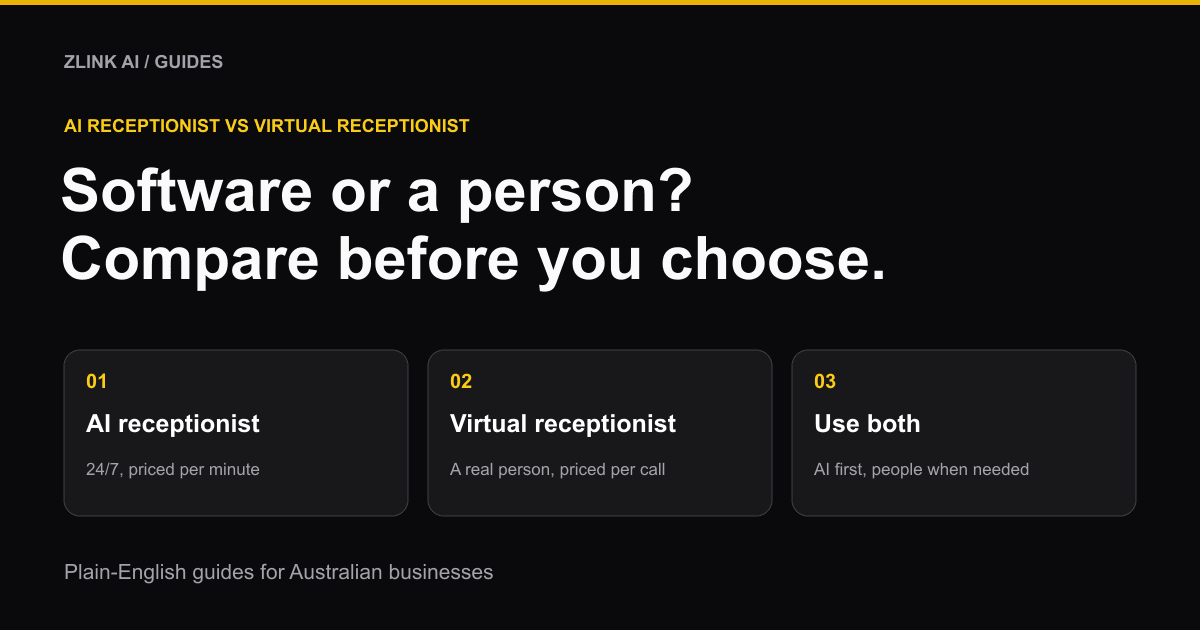
An AI receptionist is software that answers your phone with a natural-sounding voice. A virtual receptionist is a real person who answers your calls from a remote office. Both stop you missing calls. The AI is usually cheaper, works 24/7 and never puts callers on hold. The human is better with upset callers and unusual problems.
This AI receptionist vs virtual receptionist guide uses plain English and real Australian prices, so you can pick the right phone answering service for your business.
A quick note: Zlink AI builds AI receptionists, so we have an interest in this topic. To keep it fair, every price below comes from other providers' own websites (checked in October 2026).
AI receptionist vs virtual receptionist: the short answer
- Choose a virtual receptionist if most of your calls are personal, emotional or complicated, and you get fewer than about 50 calls a month.
- Choose an AI receptionist if you get lots of calls, many of them are the same few questions, or you miss calls after hours and on weekends.
- Use both if you want every call answered instantly, with tricky calls passed to a person.
What is a virtual receptionist?
A virtual receptionist is a trained person who answers your business calls from a call centre or home office. Callers hear a human voice using your business name.
Most virtual receptionist services in Australia charge per call. A typical call goes like this:
- The receptionist answers with your business name.
- They take the caller's name, number and reason for calling.
- They send you a message by email or text, or transfer the call to you.
Some services only take messages. Others can also book appointments or answer simple questions. Check what your plan includes before you sign up.
What is an AI receptionist?
An AI receptionist is a computer system that answers your phone and talks to callers like a person would. It understands what people say, answers common questions and takes action for you.
A good AI receptionist can:
- answer every call straight away, day or night;
- answer the same questions every time with the same correct information;
- book appointments into your calendar;
- take messages and send you a short summary of each call;
- pass the call to a real person when the caller needs one.
Most AI receptionists can answer many calls at the same time, so nobody waits on hold. AI receptionists are usually charged per minute or with a monthly plan.
How much does each one cost in Australia?
Here are prices published by Australian providers in October 2026. Prices change often, so always check the provider's website.
Virtual receptionist cost
OfficeHQ, a large Australian virtual receptionist service, publishes these plans (all plus GST):
- Pay as you go: $33 a month, then $3.89 for each call.
- 100 calls a month: $345.
- 300 calls a month: $960.
- 600 calls a month: $1,870.
That works out to roughly $3 to $4 per call. OfficeHQ says 24/7 answering is available if you turn on after-hours answering, but it doesn't list that price. Ask about it if after-hours calls matter to you.
AI receptionist cost
AI receptionists are usually charged by the minute or by monthly plan:
- Siptalk: 27.5c a minute, with no setup fee and no minimum spend.
- Waboom AI: $1.00 a minute pay as you go, or $910 a month for 1,165 minutes.
- Voqo: $499 a month platform fee, built for real estate agencies.
For a full breakdown, read our guide to AI receptionist cost in Australia.
A simple example: 300 calls a month
Say your business gets 300 calls a month, and each call lasts about 2 minutes. That's 600 minutes of calls.
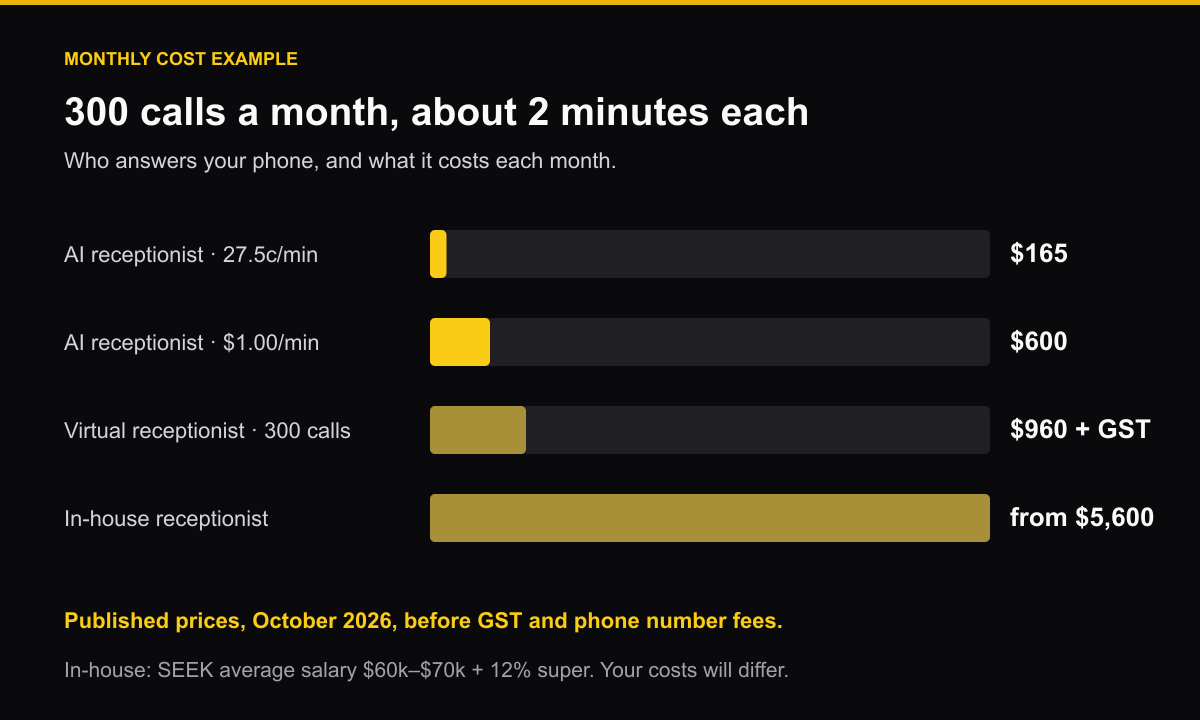
- AI receptionist: 600 minutes × 27.5c = $165 a month. At $1.00 a minute, it's $600 a month.
- Virtual receptionist: OfficeHQ's 300-call plan is $960 a month plus GST.
- In-house receptionist: SEEK lists the average receptionist salary at $60,000 to $70,000. Add 12% super and that's about $5,600 to $6,500 a month.
These figures are before GST and phone number fees. Use your own phone records to check how many calls you really get and how long they last.
Don't forget the hours
A full-time receptionist works about 38 hours a week and gets 4 weeks of paid annual leave. That's roughly 1,750 hours at the desk each year, or about 20% of all the hours in a year. Evenings, weekends and public holidays make up the other 80%. That's often when customers call.
Pros and cons at a glance
Virtual receptionist (a real person)
Pros
- A real human voice that callers trust.
- Good with upset, confused or emotional callers.
- Handles unusual questions using common sense.
Cons
- Paying per call adds up fast when you get busy.
- Many plans only take a message, so you still have to call back.
- After-hours answering may cost extra.
- They may not know your business as well as you do.
AI receptionist
Pros
- Answers every call instantly, 24/7, including weekends.
- Usually much cheaper per call.
- Doesn't get tired, sick or busy, and handles many calls at once.
- Can book appointments and update your systems, not just take messages.
Cons
- Some callers would rather speak to a person.
- It can get confused by very unusual requests or poor phone lines.
- It needs good set-up: your prices, hours, services and rules.
- You need to test it properly before you switch it on.
Which one should you choose?
Pick a virtual receptionist if:
- you get only a few calls a month;
- most calls need a human touch, such as sensitive health, legal or personal matters;
- you mainly need someone to take a message during business hours.
Pick an AI receptionist if:
- you miss calls when you're busy, on a job, or after hours;
- you get a lot of the same questions, such as prices, opening hours, availability and bookings;
- you want calls answered on weekends and public holidays without paying penalty rates;
- you want bookings and enquiries to go straight into your calendar or CRM.
Not sure? Look at your last month of calls. If most of them were simple questions or booking requests, an AI receptionist will probably save you money. If most were complicated conversations, a person may be the better fit.
The best of both: AI first, people when needed
You don't have to choose just one. A common set-up is:
- The AI receptionist answers every call instantly.
- It handles the simple stuff itself: questions, bookings and messages.
- When a caller is upset, has a complex problem or asks for a person, it transfers the call to you, your team or an answering service.
This way nobody waits on hold, you don't pay a person to answer the same question 50 times a day, and real people still handle the calls that need them.
If after-hours calls are your main problem, read our guide to the after-hours AI receptionist. It's written for real estate, but the same steps work for most businesses.
7 questions to ask before you sign up
Whichever option you choose, ask the provider these questions:
- What happens when it can't help a caller? Who gets the call, and how fast?
- Can it transfer calls to a real person? To which phone numbers, and at what times?
- How is it priced? Per call, per minute or monthly? Are there setup fees? Is GST included?
- Does it work with my calendar or CRM? Or will I have to copy details across by hand?
- Where are call recordings and transcripts stored, and for how long?
- Can I test it with my own example calls first?
- Can I cancel month to month?
For a deeper list, see our 15 tests to run before you buy an AI receptionist.
Frequently asked questions
Is an AI receptionist the same as a virtual receptionist?
No. A virtual receptionist is a real person working remotely. An AI receptionist is software that talks to callers. Some companies use "virtual receptionist" for both, so always ask whether a person or AI will answer your calls.
How much does a virtual receptionist cost in Australia?
Usually about $3 to $4 per call. For example, OfficeHQ charges $345 a month plus GST for 100 calls, and $33 a month plus $3.89 per call on pay as you go.
How much does an AI receptionist cost in Australia?
Published prices start from 27.5c a minute, and monthly plans range from about $500 to over $2,000 for busy businesses. See our full AI receptionist cost guide.
What is the best phone answering service for a small business?
It depends on your calls. If most callers ask simple questions or want to book, an AI receptionist is usually the best value. If most calls are sensitive or complicated, a virtual receptionist (a real person) may suit you better. You can also combine them: let AI answer every call and pass the tricky ones to a person.
Can an AI receptionist answer calls after hours?
Yes. Most AI receptionists work 24/7, including weekends and public holidays, with no extra after-hours charge. Check your provider's plan to be sure.
Do I need to tell callers they're talking to AI?
It's a good idea, and it builds trust. Start the call with a short line such as "You're speaking with [business]'s AI assistant." If calls are recorded, follow the recording and privacy rules that apply to your business. The Office of the Australian Information Commissioner has guidance. Get advice if you're unsure.
Ready to stop missing calls?
Zlink AI builds AI receptionists for Australian businesses. They answer every call 24/7, book appointments and pass important calls to your team. See how our AI receptionist works or book a free consultation.