Customer Service · Practical guide
AI Receptionist for Medical & Dental Clinics in Australia
A medical virtual receptionist for GP and dental clinics: what it should do, which practice software it fits, and the Ahpra and 10 December 2026 privacy rules you must follow.
Zlink AI Team7 min read
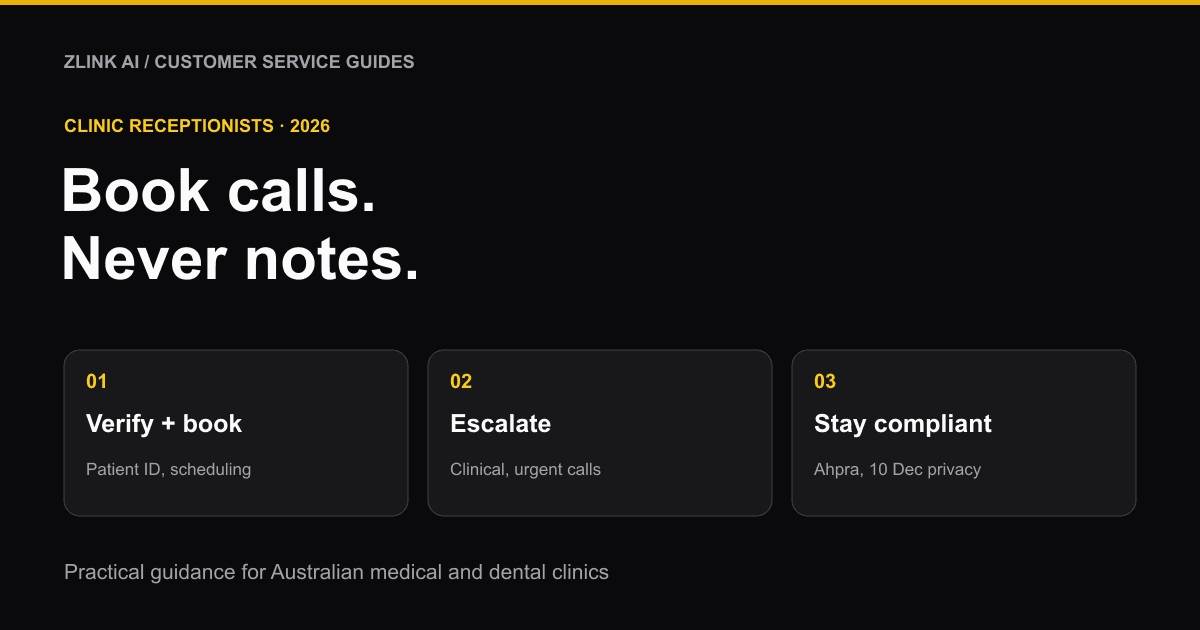
A medical virtual receptionist answers your clinic's phone, books and reschedules appointments, and passes anything urgent to a person — all without touching a patient's clinical notes. For GP clinics and dental practices, it's usually the fastest way to stop losing new patients to a busy signal or a full voicemail box.
This guide covers what an AI receptionist for a medical or dental practice should do, how it fits your existing software, and the privacy rules you need to follow, including a new rule that starts on 10 December 2026.
A quick note: Zlink AI builds AI receptionists, including for healthcare practices, so we have an interest in this topic. Every claim below links to its source.
Why clinic phones overflow
Phone calls are the biggest administrative load on a reception desk, and most of them are routine. HealthEngine's CEO, Dan Stinton, said the company's research found at least half of incoming calls at most practices relate to patient bookings (Medical Republic). That's before you count rescheduling, cancellations and simple questions like opening hours.
When reception is busy with patients at the counter, those calls go to voicemail. Some callers don't call back. They call the next clinic instead.
What should an AI receptionist for a medical practice do?
A good one follows the pattern used by HealthEngine's own AI receptionist, Helen, launched for Australian GP clinics in August 2025 (HealthEngine):
- Answer fast, every time. HealthEngine says Helen answers within three rings, 24/7, every day of the year.
- Verify the patient. Before booking, it checks the caller's name, date of birth and mobile number against existing records.
- Book, reschedule and cancel appointments for existing patients, directly into your practice software.
- Hand anything complex to a person. Clinical questions, new or unusual requests, and anything it can't confidently resolve should go to your reception team, not be guessed at.
- Never touch clinical notes. Booking and clinical records are different systems with different access rules, and an AI receptionist should only ever see the booking side.
One limitation worth knowing: Helen currently only books with GPs, not other practitioners like psychologists or physios, at clinics using Best Practice or Pracsoft (HealthEngine support). Ask any vendor exactly which practitioner types, appointment rules and practice software it supports. Don't assume.
Does it work with your practice software?
Most Australian clinics run on a handful of systems, and an AI receptionist is only useful if it actually books into the one you use.
- Best Practice and MedicalDirector/Pracsoft: both are common integration targets. HealthEngine's Helen books into Best Practice and Pracsoft, and third-party platforms like HotDoc and AutoMed also connect to these systems (AutoMed, MedicalDirector knowledge base).
- Cliniko: has its own connected-apps marketplace, listing several AI receptionist options built specifically for Cliniko users (Cliniko connected apps).
- Ask directly, don't assume. Vendor marketing pages are where most of this integration information comes from, so confirm live with your own practice management system before signing up, not from a feature list alone.
The rules: privacy and professional responsibility
Healthcare is one of the most tightly regulated places to use AI in Australia, for good reason: you're handling people's health information, which the Privacy Act treats as sensitive information requiring extra care.
Ahpra's guidance for practitioners
Since August 2024, Ahpra has published guidance explaining how existing codes of conduct apply when a registered health practitioner uses AI. It applies across all 16 nationally regulated health professions, and it's built on four principles: accountability, understanding, transparency and informed consent (MinterEllison).
In plain terms:
- You stay responsible for anything AI does in your practice. Even a tool you didn't build.
- Tell patients when AI is involved in answering their calls or booking their appointment. Note their consent.
- Understand how the tool handles data. Know how it collects, stores and discloses patient information.
The 10 December 2026 privacy rules
From 10 December 2026, new Privacy Act requirements specifically target healthcare's use of automated decision-making. Avant, the medical defence organisation, says practices whose AI-enabled workflows significantly affect patients will need to disclose this in their privacy policy, and that policy must be updated before the deadline (Avant).
Avant's own guidance adds a pointed warning: most AI tools on the market aren't configured for healthcare use and may not meet Australian privacy law requirements out of the box. You, not the vendor, stay responsible for AI-generated output that influences a patient's care, even when a third party markets or approves the tool.
What this means for a receptionist tool specifically: booking and triage decisions are less likely to trigger this rule than clinical decision-support tools, but check with your own adviser. The safer approach either way is a receptionist that only handles bookings and simple questions, with everything else going to a person, and a privacy policy that already explains this.
Keep health information separate and minimal
- Have the AI receptionist collect only what it needs to verify identity and book an appointment: name, date of birth, mobile number.
- Never let a booking tool access or store clinical notes.
- Confirm in writing where the vendor stores call recordings and transcripts, and for how long.
A dental answering service: what's different
A dental answering service handles the same booking-heavy calls as a GP clinic, with a few differences worth planning for:
- Emergency vs routine triage. A caller in pain today needs a different response from someone booking a six-month check-up. Decide upfront what counts as urgent, and route those calls to a person immediately.
- Recall campaigns. Dental practices often run reminder calls for overdue check-ups. An AI receptionist can handle inbound calls from these campaigns, freeing your team to focus on the campaign itself.
- Treat vendor statistics on missed calls with caution. Most published figures on missed-call rates and lost revenue for dental practices come from companies selling AI phone tools, several share suspiciously similar numbers, and most aren't Australian. Track your own missed-call rate from your phone system for a month before you decide whether this is worth solving.
What it costs
Published Australian pricing is limited, but one concrete example: HealthEngine bundles Helen with its online booking software for $20 per practitioner, per month (HealthEngine). That's a healthcare-specific bundle, not a general per-minute AI receptionist rate.
For a wider comparison of what AI receptionists cost in Australia generally, including per-minute and monthly plans from non-healthcare-specific providers, see our guide to AI receptionist cost in Australia. If you're still deciding between a person and software, AI receptionist vs virtual receptionist walks through the trade-offs in plain English.
How to start
- Track your current missed-call rate for a few weeks using your phone system's own records, not a vendor's estimate.
- List your must-haves: which practice software it must integrate with, which practitioner types it needs to book for, and what counts as urgent.
- Check the vendor's healthcare credentials specifically. A generic AI receptionist built for retail or trades may not handle health information correctly. Ask how it meets Privacy Act requirements for sensitive information.
- Start with bookings and simple questions only. Leave clinical triage, prescriptions and anything patient-specific to your team at first.
- Update your privacy policy and patient consent material before 10 December 2026, regardless of which tool you choose.
- Test it with real scenarios: a new patient, a cancellation, an urgent-sounding call, and a request it can't handle. See our 15 tests before you buy an AI receptionist for a checklist you can adapt from real estate to healthcare.
Frequently asked questions
Can an AI receptionist access my patients' medical records?
It shouldn't. A well-built AI receptionist only needs enough information to verify identity and manage a booking: name, date of birth and contact details. Clinical notes should stay in a separate system the receptionist never touches.
Is it legal to use an AI receptionist in an Australian medical practice?
Yes, but you must follow Ahpra's guidance (accountability, transparency, informed consent) and the Privacy Act, including the new automated decision-making disclosure rules starting 10 December 2026. Get advice from your medical defence organisation or a privacy adviser if you're unsure.
Do patients need to be told they're talking to AI?
Ahpra's guidance says to inform patients when AI is involved and to note their consent. A simple line at the start of the call, such as "You're speaking with [clinic]'s AI assistant," is a reasonable starting point.
What is an AI receptionist for a medical practice?
It's software that answers your clinic's calls, verifies the patient and books, reschedules or cancels appointments directly in your practice software. It hands anything clinical or unusual to a person, and it never accesses medical records.
Does an AI receptionist work with Best Practice, MedicalDirector or Cliniko?
Several vendors integrate with these systems, but exact support varies by practitioner type and configuration. Always confirm directly with the vendor and your practice software provider before signing up.
Get help setting up an AI receptionist for your clinic
Zlink AI builds AI receptionists for Australian businesses, including medical and dental practices. Book a free consultation and we'll help you work out whether it fits your practice software and your patients.