AI Insights · Practical guide
Data Centres in Australia: Benefits, Risks and Where They Should Be Built
Why data centres are a long-term national asset for Australia, what they are worth to people and government, their real costs in power, water, noise and jobs, and where they should and should not be built.
Zlink AI Team12 min read
A data centre is a large, secure building full of computers called servers. They store data and run the online services we use every day, like banking apps, email, streaming and AI tools such as ChatGPT. An AI data centre is the same idea, only bigger. It is packed with special chips that use far more power.
Australia is in the middle of a data centre boom. Billions of dollars are pouring in. At the same time, some communities are pushing back against projects near their homes. This guide explains, in plain English, what data centres are worth to everyday Australians and to the country in the long run. It also covers why Australia suits them, and where they should and shouldn't be built.
A quick note: Zlink AI builds AI tools for Australian businesses, and those tools run in data centres, so we have an interest in this topic. We've tried to give both sides fairly, and every number below links to its source so you can check it yourself.
The short answer
- Data centres are a long-term national asset. They keep our data onshore, bring in big investment, support AI and can help pay for new clean energy. Saying no to all of them would leave Australia behind in one of the most important technologies of our time.
- They also have real costs. They use a lot of power, and older designs can use a lot of water. They can be noisy. And they create far fewer long-term jobs than many people think.
- Location is everything. Picture one on industrial land, run on new solar and wind, and cooled without drinking water. Now picture one on farmland next to homes, a school and a bushfire-prone road. They are very different things.
How many data centres are there in Australia?
The energy market operator, AEMO, counts around 165 data centres connected to the main east coast grid. Together they used about 5 terawatt hours of electricity in 2025–26, roughly 3% of the grid's power (AEMO).
Most are in Sydney and Melbourne. Sydney is the third largest data centre market in the Asia-Pacific region and Melbourne is the eighth (Austrade). There are also data centres in Brisbane, Perth, Adelaide, Canberra and Darwin.
Why are so many data centres being built in Australia?
Two big reasons: AI, and the fact that Australia suits data centres unusually well.
AI needs enormous amounts of computing power. Some of the largest recent commitments:
- Amazon Web Services plans to invest A$20 billion in Australian data centres from 2025 to 2029, including three new solar farms (Austrade).
- NEXTDC and OpenAI have announced plans for a roughly A$7 billion AI campus at Eastern Creek in Western Sydney, designed for government, defence, finance and health workloads, subject to planning approval (ACS Information Age).
- Industry research forecasts Australia's data centre capacity will more than double from 1,350 megawatts in 2024 to 3,100 megawatts by 2030 (Mandala report for AirTrunk, AWS, CDC, Microsoft and NEXTDC).
Why Australia is a good fit for data centres
Australia has a rare mix of advantages:
- Connections to the world. Australia has 17 subsea internet cables to Asia and beyond, with more being built (Austrade).
- Plenty of sun, wind and space. Austrade calls Australia a great location for green data centres because of its renewable energy resources. Large data centres need large, steady power supplies, and Australia can build renewable energy at scale.
- Close to Asia. Western Australia and the Northern Territory share time zones with much of Asia. Darwin already has a NEXTDC data centre and international subsea cable links, and the NT Government is actively seeking more digital investment (NT Government).
- Stable and trusted. Strong laws, a stable government and good security make Australia a safe place to store sensitive data, for Australians and for businesses in our region.
- Cheaper than some rivals. Austrade says it can be cheaper to build and run data centres in Australia than in competing Asian locations such as Singapore.
What data centres are worth to everyday Australians
Your data stays in Australia
When your bank, hospital or government stores your data in an Australian data centre, it stays under Australian law. That matters for privacy and security. Many health, finance and government services must keep some data in Australia. Local data centres let AI services do the same.
Faster, more reliable services
Data stored close to you loads faster. It is also less likely to be cut off if an overseas cable breaks. As more services use AI, local computing power means quicker answers and fewer outages.
Jobs, but mostly during construction
This is where expectations need to be realistic.
- Building a data centre creates a lot of work. Research cited by the University of Melbourne suggests there are potentially 15 construction jobs for every permanent job at a data centre (University of Melbourne).
- Once it's running, a data centre needs relatively few people. The industry's own forecast is for the operational workforce to grow by about 8,300 jobs to 17,900 by 2030 (Mandala). These are skilled roles such as electricians, engineers and IT technicians.
So a data centre is a big short-term boost for local builders and trades, but not a large long-term employer.
The long-term value for government and the country
For governments, the value goes beyond a single building.
- Sovereignty and security. Defence, government and critical services need computing power that stays under Australian control. A country without its own data centres has to rely on facilities overseas.
- A seat in the AI economy. The Australian Government's national expectations for data centres include giving Australian start-ups and researchers access to computing power and building local skills (Department of Industry, Science and Resources).
- Paying for new clean energy. Data centres need steady power for decades, which makes them reliable customers for new wind, solar and storage. The federal expectations say developers should pay for new renewable supply and their full share of grid connections, so the costs aren't passed on to households and other businesses.
- Investment. Billions of dollars of private money flows into construction, energy projects and local suppliers.
The catch is that these benefits only arrive if the rules make developers carry their own costs. That's why the next section matters.
Why data centres are a long-term national asset
It helps to think of data centres the way we think of ports, power lines and the NBN. They are infrastructure. Once built, they serve the country for decades and are upgraded as technology changes.
AI is one of the biggest technology shifts of our lifetime
AI is shaping up to be as important as electricity and the internet. Every hospital, bank, school, farm and small business will use it in some way. And all of it runs on computing power in data centres.
The Productivity Commission estimates AI could add around A$116 billion to Australia's economy over the next decade (Productivity Commission final report, via King & Wood Mallesons). The government's National AI Plan, released in December 2025, puts computing power and data centre capacity at the heart of that goal (MinterEllison).
Saying no doesn't stop AI. It just moves it overseas.
If Australia refuses to build data centres, Australians won't stop using AI. We'll simply use AI that runs on computers in other countries. That means:
- Our money goes overseas. The investment, construction work, skilled jobs and taxes go to whichever country builds the data centres instead.
- Our data leaves Australia. Sensitive health, financial and government information would sit under other countries' laws.
- We depend on others. In a crisis, a country without its own computing power has to rely on the decisions of foreign governments and companies.
- We fall behind. Researchers, start-ups and businesses get faster, cheaper access to AI when the computing power is local.
Other countries in our region are competing hard for this investment. Australia's advantages, like subsea cables, renewable energy, land and stable laws, give us a real chance to become a data centre hub for the Asia-Pacific. Austrade notes Australia can even back up data and computing for customers across Asia (Austrade).
The smart answer isn't "yes to everything" or "no to everything". It's "yes, in the right places, on fair terms." That's how Australia gets the long-term asset without the local damage.
The costs and limits: what people are worried about
Electricity and power bills
Data centres are power-hungry, and AI makes it worse. AEMO forecasts data centre electricity use will grow from about 5 TWh (3% of grid power) in 2025–26 to about 34 TWh (around 13%) by 2035–36 (AEMO).
If that power comes from burning more gas or keeping old coal plants open, everyone pays. The Climate Council warns that without strict rules, wholesale power prices could rise by up to 26% in NSW, 23% in Victoria and 14% in Queensland by 2035 (Climate Council). That's a worst-case warning, not a certainty. But it's why governments now expect data centres to bring their own new clean energy.
Water
Some data centres cool their servers by evaporating water, a bit like a giant evaporative air conditioner. Today, data centres use only about 0.7% of Sydney's water. But Sydney Water told a NSW parliamentary inquiry that if proposed data centres go ahead with water-intensive cooling, they could need up to 250 megalitres a day by 2035, more than Canberra's entire drinking water supply (AAP). Industry estimates are much lower, and the real figure depends on the cooling technology used.
The good news: newer data centres use far less water. Many new AI data centres use closed-loop cooling. The system is filled with water once, and that same water goes round and round between the chips and the coolers, like the radiator in your car. Nothing is evaporated, so almost no new water is needed for cooling.
- Microsoft says every new data centre it has designed since August 2024 uses zero water for cooling, saving more than 125 million litres a year at each site. Some water is still used for kitchens and bathrooms (Microsoft).
- In Sydney, the planned OpenAI and NEXTDC AI campus has reportedly switched to closed-loop liquid cooling (Data Center Dynamics).
- Amazon is connecting a new data centre near Melbourne to a recycled water plant in Melton, the first data centre in Victoria to use treated water (AAP).
Two honest catches. Closed-loop cooling usually needs more electricity than evaporating water. And power stations use water too, so a data centre's electricity has a water cost of its own. Not every data centre uses closed-loop cooling yet, which is why the cooling method is one of the best questions to ask about any proposal.
How data centre water use compares
Data centres are often described as huge water users. Compared with everyday uses, they are smaller than most people think. Australia doesn't publish national figures, but the United States does:
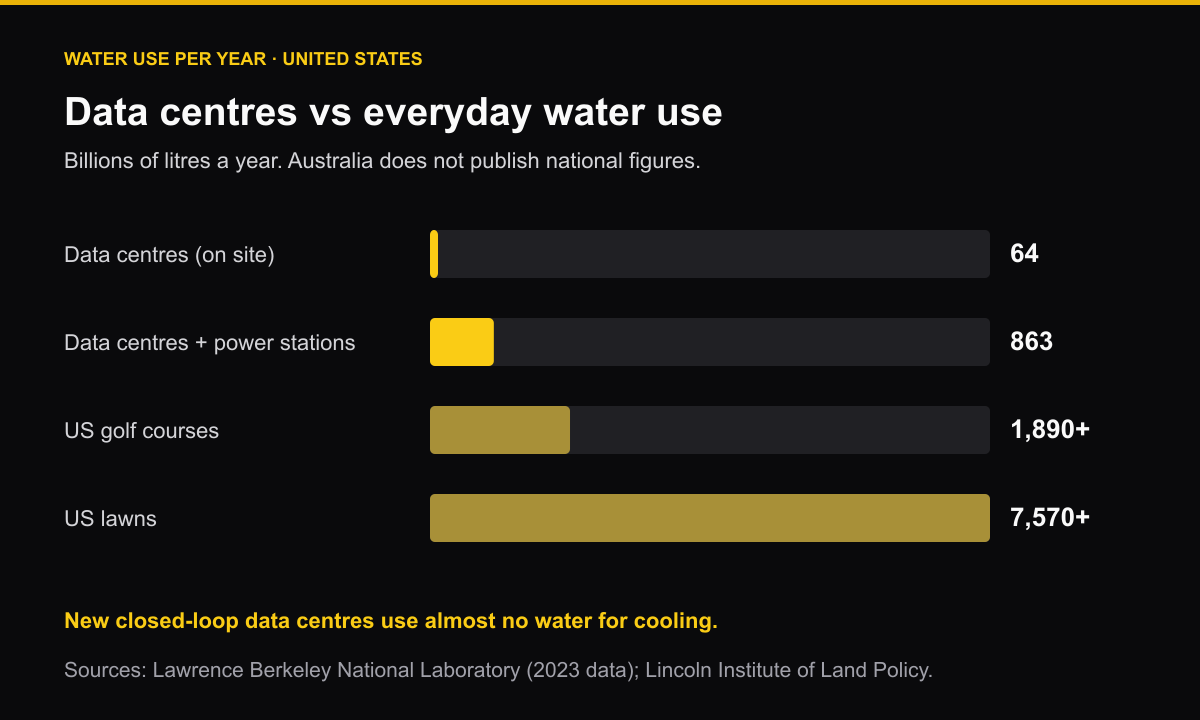
- In 2023, US data centres used about 17 billion gallons (64 billion litres) of water on site for cooling. Counting the water used by the power stations that supply their electricity, the total was about 228 billion gallons (863 billion litres) (The Conversation, citing Lawrence Berkeley National Laboratory).
- Americans use more than 500 billion gallons a year watering golf courses and more than 2 trillion gallons watering lawns (Lincoln Institute of Land Policy).
Critics make a fair point: national totals hide local problems. One large data centre drawing drinking water from a small town's supply can still cause real stress, even if the national number looks small. That's why location and cooling method matter more than the national average.
Noise
Data centres hum. The noise comes mainly from cooling equipment, plus backup diesel generators when they're tested. Experts from UNSW and RMIT note that residential night-time noise limits in Australia are typically 35–40 decibels, about as loud as a quiet library. They found no research linking data centre noise to health problems, but new noise can cause real annoyance and stress, especially at night (UNSW).
Noise has already stopped projects. Victoria's EPA objected to a data centre in Campbellfield over noise, and a council in Hazelmere, WA, rejected one partly because it was close to homes and a school.
Land, bushfire, traffic and dark skies
Big data centres need big sites, heavy trucks while they're built, and strong power lines. On rural land, that can mean lost farmland, more traffic on small roads and more bushfire risk.
Fewer permanent jobs than promised
As above, permanent jobs are modest compared with the money invested. Communities are right to ask what a project leaves behind once the builders go home.
Where data centres should not be built
Recent news shows what happens when a project lands in the wrong place. On 12 November 2026, Quantum DC paused its plan for a 1,200-megawatt AI data centre at Tungkillo in the Adelaide Hills after strong local opposition. Residents raised water, energy, noise, lighting and the night sky, traffic, bushfire risk and farmland. The developer said it had "misread the strength of feeling". South Australia's Premier said the state needs a strict framework to stop data centres being proposed in unsuitable places (ABC News).
Based on what communities, experts and regulators keep raising, data centres generally should not be built:
- Right next to homes, schools or hospitals without proper distance and noise protection.
- On productive farmland or in bushfire-prone areas with narrow or unsealed roads and limited fire services.
- Near dark-sky reserves or quiet rural areas where 24/7 lighting and hum would change the character of the place.
- In water-stressed areas if they plan to cool with drinking water.
- Where the local grid can't cope without delaying other users or relying on more fossil fuels.
- Where the community hasn't been properly consulted before the plans are lodged.
Where data centres make sense, and are wanted
The same projects can work well somewhere else. Good locations usually have most of these:
- Existing industrial or employment land, away from homes, with good roads and power lines already in place.
- New renewable energy nearby, ideally built or contracted for by the data centre itself.
- Recycled water or closed-loop cooling, so no drinking water is used for cooling.
- Strong internet connections, such as near subsea cable landings.
- A community that wants the investment, with agreed local benefits like jobs, training, local contracts or a community fund.
Some places are actively asking for data centres. The Northern Territory Government is promoting Darwin as a gateway to Asia, with subsea cables and land set aside for digital infrastructure (NT Government). Tasmania has released draft expectations that new data centres must deliver jobs, support renewable energy and use water responsibly, while its parliament holds an inquiry so the community has a say (Tasmanian Premier).
This is the pattern that works: welcome the investment, but on clear terms the community has agreed to.
What the rules say now
- Federal: In March 2026 the Australian Government published national expectations for data centre and AI infrastructure developers. Projects that pay for new renewable energy, manage water and community impacts, support data sovereignty and build local skills will be prioritised. Energy-hungry projects that don't will not (Department of Industry, Science and Resources).
- States: Each state controls planning and noise rules. Tasmania has draft expectations and a parliamentary inquiry. South Australia's Premier has called for new laws after the Tungkillo pause. NSW has backed the national expectations (Gilbert + Tobin).
The rules are still catching up with the boom, so expect more changes in 2027.
7 questions to ask about a data centre near you
If a data centre is proposed in your area, these questions will tell you a lot about whether it's a good deal:
- Where will its electricity come from? Is it paying for new renewable energy, or drawing on the existing grid?
- How will it be cooled? Closed-loop or recycled water, or drinking water?
- How loud will it be at night at the nearest home, and who checks it after it opens?
- How many permanent local jobs will there be, not just construction jobs?
- What does the community get? Training, local contracts, a community fund, better roads?
- How far is it from homes and schools, and what's the bushfire and traffic plan?
- Who can you complain to if the promises aren't kept?
What this means for Australian businesses using AI
Every AI tool your business uses, from chatbots to AI receptionists, runs in a data centre somewhere. Two practical takeaways:
- Ask where your data is stored. If you handle customer, health or financial information, choose tools that can keep it in Australia.
- Use AI where it saves real time. AI uses real energy, so it's worth putting it to work on tasks that genuinely matter, like answering customer calls or cutting hours of admin, rather than for the sake of it.
If you want help using AI sensibly in your business, Zlink AI builds AI receptionists, AI chat agents and AI automation for Australian businesses. Book a free consultation and we'll help you find where AI is worth it.
Frequently asked questions
Why are data centres important for Australia's future?
AI is becoming one of the most important technologies in the world, and it runs on data centres. Building them here keeps Australian data under Australian law, brings investment and skills, and means our businesses, researchers and government aren't dependent on computing power overseas.
Why are they building so many data centres in Australia?
Mainly because of AI, which needs huge amounts of computing power, and because Australia is a good location: subsea cables to Asia, plenty of land and renewable energy, a stable legal system and growing demand for data to be stored onshore.
Are data centres bad for the environment?
They can be. They use a lot of electricity, and some use a lot of water. The impact depends on how they're built: one powered by new renewable energy and cooled with recycled water has a much smaller footprint than one running on fossil-fuel power and cooling with drinking water.
Do new data centres use water?
Many new data centres use very little. Closed-loop cooling fills the system with water once and recirculates it, so almost no new water is needed. Microsoft says all its new data centre designs since August 2024 use zero water for cooling. But older designs that evaporate water to cool down can use millions of litres a day, and closed-loop systems usually use more electricity instead.
How much water do data centres use?
It varies widely by cooling method. Water-cooled data centres can use millions of litres a day, while closed-loop systems use very little. Sydney Water has projected data centres could need up to 250 megalitres a day by 2035 if proposals go ahead with water-intensive cooling, though today they use only about 0.7% of Sydney's water and industry estimates are much lower.
Is it safe to live near a data centre?
Experts from UNSW and RMIT found no research linking data centre noise to health problems, and Australian noise limits broadly match World Health Organization guidelines. The bigger issues for neighbours are usually constant low hum, lighting, construction traffic and generator testing, which is why distance and good design matter.
Do data centres create jobs?
Yes, but mostly during construction. Once running, a large data centre employs a relatively small team of skilled technicians, electricians and engineers. Industry forecasts expect about 8,300 extra permanent data centre jobs across Australia by 2030.
Will data centres push up my power bill?
They could if their demand is met by existing or fossil-fuel power. That's why the federal government now expects new data centres to pay for new renewable energy and their full share of grid connections, so the cost isn't passed on to households.
Where are the data centres in Australia?
Most are in Sydney and Melbourne, with others in Brisbane, Perth, Adelaide, Canberra and Darwin. New AI data centres are also being proposed in regional areas, including Tasmania, South Australia and the Northern Territory.